Reliable diagnostic tools are essential for maintaining poultry health. The oocyst per gram (OPG) count and qPCR are two useful techniques to assess coccidiosis in chickens. Tracking these counts on a vaccination attenuated by precocity over time reveals a typical pattern: an initial rise, followed by a peak, and then a decline, as discussed previously here. Understanding this pattern is crucial for effective coccidiosis control and overall flock health.
However, this post focuses on cases that deviate from this typical curve. Fecal sampling is performed at 28-31 days post-vaccination to assess field strain replication and at 21-23 days post-vaccination to assess vaccine replication.
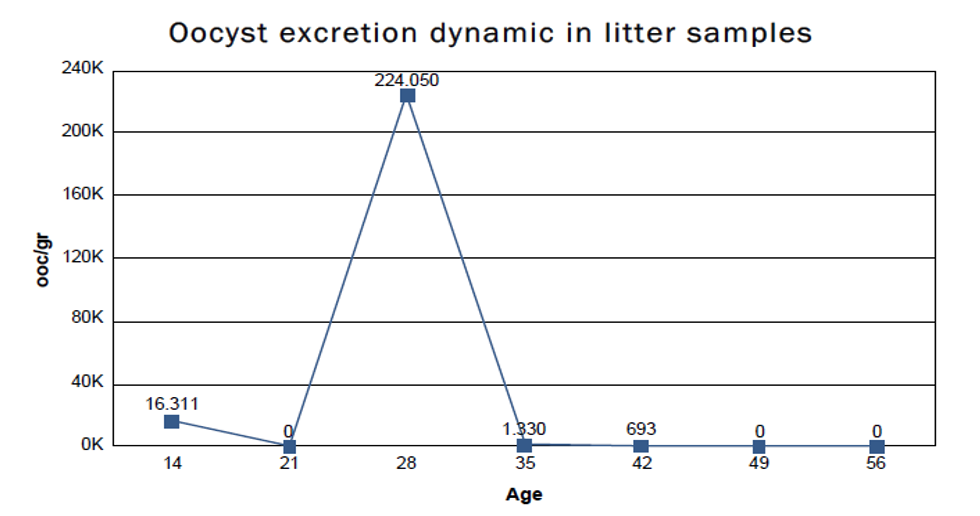
This graph presents data from a real-world case, showing a single instance of vaccine replication at 14 days post-vaccination. No replication was detected at 7 or 21 days, suggesting a failure to establish adequate immunity. This occurred during a high field challenge, evidenced by an OPG of 224,050 (values above 60,000 typically indicate field replication in addition to, or instead of, vaccine replication). The affected animals showed signs of coccidiosis and were treated accordingly. Further investigation was conducted to determine the cause of the lack of replication at 7 and 21 days, including analysis of humidity, temperature, and vaccine application technique.
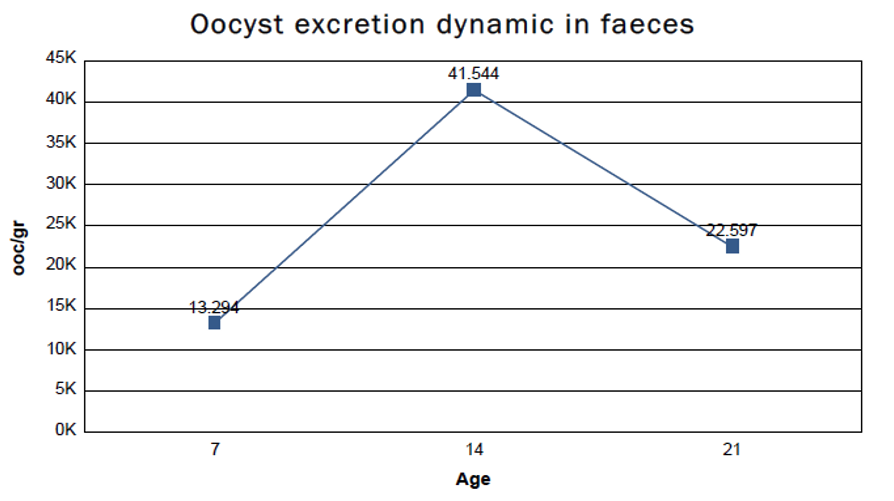
This graph presents data from another field case demonstrating robust vaccine replication, with noticeable peaks at 7 days (13,298 OPG), 14 days (41,544 OPG), and 21 days (22,597 OPG). The high OPG count at 14 days initially raised concerns about a potential coccidiosis outbreak. However, when vaccination protocols and litter management are optimized, environmental factors can promote strong vaccine replication, resulting in elevated OPG values. The subsequent decline in OPG at 21 days, rather than a continued increase, suggests minimal field pressure. Therefore, in this case, the observed counts are not a cause for alarm.
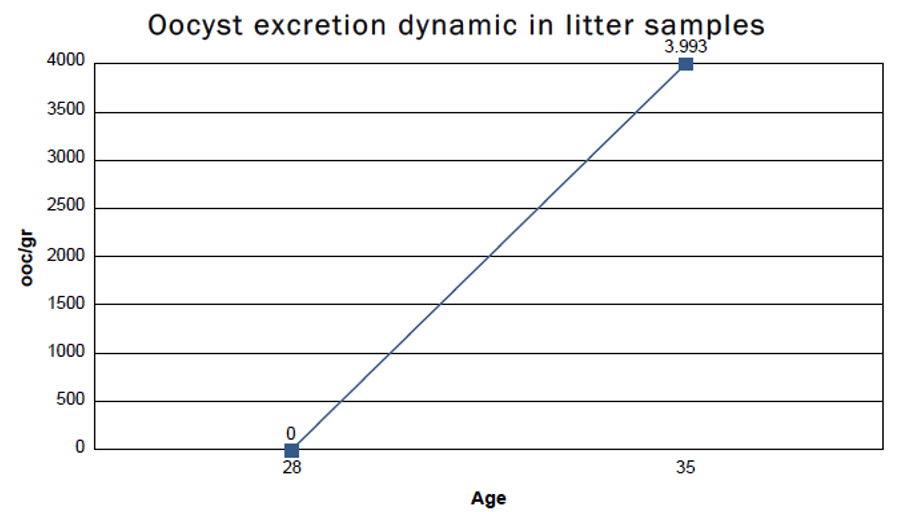
Not all cases follow the expected pattern. This real-world example shows OPG remaining at zero until 28 days post-vaccination. While field strain replication can rarely occur between 14 and 28 days (and especially when litter is recycled), replication during this period is more often attributable to the vaccine. Delayed vaccine replication, potentially due to suboptimal farm conditions, can also lead to a peak at 28 days.
Ideally, all five Eimeria species present in the vaccine should be detectable by PCR at 7, 14, and 21 days post-vaccination. However, these species vary in their reproductive potential:. E. tenella, E. necatrix, and E. brunetti have lower reproductive potential, thus it is paramount the use of qPCR to identify them.. As this is a semi-quantitative technique, it’s best interpreted in conjunction with oocyst counts from the same sample.
Following vaccination, chickens are exposed to coccidia from both the vaccine (vaccine oocysts) and the environment (field strains), resulting in ongoing immune stimulation. While vaccinated chickens will excrete oocysts, the number varies depending on established immunity and, crucially, the environmental coccidia load. It is essential to avoid administering anticoccidials based solely on elevated OPG counts post-vaccination, as this can disrupt the development of vaccine-derived immunity, leaving birds susceptible to more pathogenic field strains. Anticoccidial treatment should only be considered in cases of significant lesion scores or outbreak-related mortality.
Therefore, monitoring should not rely solely on OPG counts. Integrating other diagnostic techniques, such as PCR and lesion scoring, is crucial for accurate diagnosis.